Renzo
Arbore
is the most eclectic charismatic personality in the world
of Italian show business: music, radio and television entertainment.
Writer,
presenter and director of television/radio programs, showman,
film director, musician, song writer and composer, music critic
and journalist, he invented new genres, he discovered many
new talents, just to name one: Roberto Benigni. He rediscovered
important musical genres (the humoristic song, Italian swing,
the Neapolitan song) and he managed to invent a new style,
which in Italy is known as "arboriano"; entertaining,
innovative and intelligent.
He
was born in 1937 in Foggia, a city located in southern Italy,
where studied classical subjects. He then moved to Naples
where he graduated in Law. It was during this time that he
developed his great passion for Jazz (collecting records and
playing the clarinet in jazz clubs) and the "Classic
Neapolitan song"; some of his favourite artists were
Roberto Murolo and Renato Carosone.
He
has lived in Rome since 1964, but for work and …curiosity
he continually travels around the world.
After
a different kind of television, radio and cinema, Arbore has
dedicated the last 18 years of his career to the Neapolitan
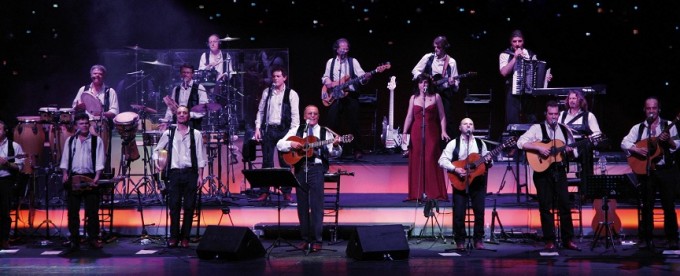
song; putting together the Italian Orchestra, a group of 16
members who started off from a classical model and with great
class carry out their mission to relaunch the Neapolitan song
all over the world. Along with his orchestra Arbore has performed
in some of the greatest theaters in the world, from New York
to Moscow, from London to Sydney, from Buenos Aires to Paris,
from Tokyo to Beijing…achieving extraordinary success
and winning over an international audience.
RENZO
ARBORE FORMS The ITALIAN ORCHESTRA
Since
1991 Renzo Arbore, great and deep estimator of music and Classical
Neapolitan Song wanted to pursue his personal "dreams":
to give birth to a personal orchestra, an "Italian"
orchestra made of guitars, mandolins, musicians' voices and
choirs, percussions, accordion and keyboards, to promote the
Classical Neapolitan Song in Italy and abroad. He was inspired
by the '900 naïf Neapolitan Orchestras, where the singer's
voices rich with pathos along with the streets rhythm of Naples
created a marriage of harmony. Arbore rediscovered the primary
importance of the forgotten mandolin sound and was delighted
to experiment with rock, blues, country, reggae, South American
rhythms which he incorporated in his music. He introduced
new rhythmic energies to support the sonority which were never
heard before. In a way, Arbore and the Italian Orchestra were
bringing attention to the Italian and international audiences,
the classic Neapolitan sound as "modern" music.
This music is still alive and is able to express the most
intense and overwhelming emotions. His goal to create a modern
sound with traditional melodies was
difficult because the real "Neapolitan sound", the
great tradition "without time" and "without
fashion", was considered (eighteen years ago...) by many
artists and critics (but not from the wise and cultured Neapolitans)
… "out of fashion". It was an expression of
Naples that "once was", a Naples "by postcard",
a Naples with "pizza and mandolin". To succeed,
if not defeat, or at least to neutralize minor stereotype
in making this "new/classic" Naples' sound with
renewed emotion and new found dignity in the great theatres
of Italy and of the world has been "the dream" of
Arbore. It also has become reality. After the international
debut of the "Italian Orchestra" at the prestigious
Montreux Jazz Festival (1991), Renzo Arbore was baptized by
Quincy Jones as "the new Italian renaissance man"
… of music and of the Italian creative spirit. Following
hundreds and hundreds of concerts in the Italian squares,
theatres and unforgettable concerts in New York at Radio City
Music Hall (1993), Madison Square Garden (1994) and Carnegie
Hall (2004), at Royal Albert Hall in London (1995), the Olympia
in Paris (1997), the Red Square of Moscow (1996) and many
other concerts in Canada, Australia, Brazil, Japan, Argentina,
Venezuela, Tunisia, Spain, Montecarlo, Malta, he received
a clamorous welcome in China where he played the theatres
of Beijing, Shanghai, Hangzhou, Tianjin e Nainjin at the beginning
of 2007. In the hands of Arbore and his 15 great talented
musicians (all of them great soloists of their own instrument),
are going to bring a new light to some Neapolitan musical
gems.
These revisited gems exalt the poetry, the fun, the extraordinary
"beauty", and the "moment". Here are some
of them: "Era de maggio", "Voce 'e notte",
"Luna Rossa" "Malafemmena", "Dicitincello
vuje", "Reginella", "Munasterio 'e Santa
Chiara", "Comme facette mammeta", "Aummo...
aummo", "'O Sarracino", "Chella llà",
also "Silenzio cantatore", "Scetate",
"Mandulinata a Napule", "Ll'arte d'o sole",
"I' te vurria vasà", "Na sera e maggio",
"Canzone appassiunata", "Te voglio bene assaje",
"Canzone Marenara" and many songs "cautiously"
covered. Roberto Murolo and Renato Carosone were the inspiration
for Arbore. He remembers affectionately their voices and soul
from each concert.
Classical
Neapolitan songs reached the hit parade charts for the first
time in history with the release of the group's first three
CDs "Napoli punto e a capo" (1992), "Napoli.
Due punti e a capo" (1993) e "Napoli, Punto esclamativo!"
(1995).
Around
the same time, the newspapers from all over Italy wrote headlines
such as: "Naples royalty returns to sing" …
"Arbore sings Naples" … "Arbore, the Neapolitan
wants to reunite Italy" … "Music for a new
Italian image" … "act of love for Naples and
southern of Italy" … Indeed "Napoli punto e
a capo" becomes his personal slogan. In fact, Arbore
never has abandoned to believe that from one spark this song
could resurface this noble city, the greatest hotbed of artists
- of the music and of the word - of our country. In 1996 his
fourth
disc titled "Pecchè nun ce ne jammo in America?",
which also contains classic Neapolitan songs, is an original
single written with Peppino Gagliardi and Beniamino Esposito.
This single is about two Arbore-ian souls, one pro American
and one pro Neapolitan which slowly and eventually rationalize
the question: "....pecchè nun ce ne jammo in America?"
(...why don't we go to America?). Keeping in mind taste and
trend not only in music but that anywhere in the world the
south shares an extraordinary similarity. The idea that people
and places have communalities, such way of life, joy, suffering,
eating, dancing which renders them similar to a patriotic
state….the united states of the south. In 1998 Arbore
records the fifth disc of Italian Orchestra titled "Sud(s)"
in which his musical companions have fun giving life to exotic
remakes, mixing, reconstructing sound, atmosphere, scenery….and
smells. Smells of the earth and people far away but close
by, from Santo Domingo to Portorico, from Cuba to Brazil,
to Africa. With rhythms from these countries translated into
the Neapolitan language. Today these five CDs, filled with
authentic gems of classic Neapolitan songs and some diverse
napol-Arbore-ian, after years of requests by passionate and
new fans of the
"Renzo Arbore and the Italian Orchestra" repertoire,
are published by Warner Music in a precious compilation (3cd,
47 songs, almost 4 hrs of music for every taste and latitude).
A triple box whose title could not be more appropriate: "Diciottanni
of… Neapolitan songs (…those beautiful ones)"
one great festivity of birthday for the maturity of Italian
Orchestra.
On
stage Renzo Arbore is surrounded by 15 talented musicians,
"...all star", as he likes to call them. Some of
the features which stand out among them are: the passionate
singing of Gianni Conte, the seductive voice of Barbara Buonaiuto,
the ironic voice of Mariano Caiano, the acrobatic vocal and
rhythmic virtuoso performances of the special guest Gegè
Telesforo. Not to mention: the orchestral direction and the
piano of Massimo Volpe, the guitars of Michele Montefusco,
Paolo Termini and Nicola Cantatore, the accordion of Claudio
Catalli, the percussions of Peppe Sannino, the drums of Roberto
Ciscognetti, the bass of Massimo Cecchetti, and last but not
least, the tormenting and joyous mandolins of Nunzio Reina,
Gennaro Petrone and Salvatore Esposito.
The
combination of all sounds along with a rich mixture of captivating
choruses and instrumental solos create a roller-coaster of
contrasting emotions which are unleashed on stage; a wave
of melody and sound which make one think of exotic scenery
like sunrises, sunsets, parties in the sun and nighttime serenades,
of the joy and suffering of love. Slowly audiences from all
over share in the illusion of finding themselves in the land
where all these emotions originated, under the sun which illuminated
and warmed them, among the scents of a land, Italy, which
is a place where the soul can breathe; it awakens and calms
down, cries and smiles, and once again goes to sleep happy,
awaiting a new day to invent.
Info
tour: +39 06 39742281